
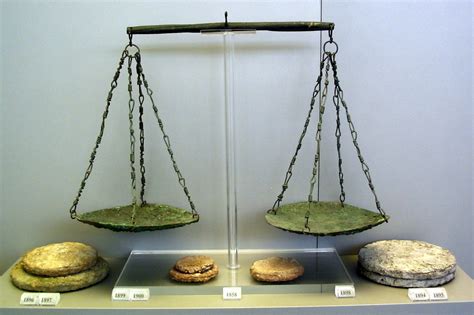
Bronze balance pans and lead weights, Vapheio tholos tomb, Laconia. Late Helladic (LH) II (15th c. BCE) National Museum, Athens
הֶֽעָשִׁ֣יר לֹֽא־יַרְבֶּ֗ה וְהַדַּל֙ לֹ֣א יַמְעִ֔יט מִֽמַּחֲצִ֖ית הַשָּׁ֑קֶל לָתֵת֙ אֶת־תְּרוּמַ֣ת ה’ לְכַפֵּ֖ר עַל־נַפְשֹׁתֵיכֶֽם
the rich shall not pay more and the poor shall not pay less than half a shekel when giving an offering to HaShem to atone for your souls. (Ex 30.15)
This Shabbat is called by two names: mishpatim, referring to the part of the Torah we are reading, and shekalim, a word which comes to denote money, but is derived from the word “balance”. This recalls the ancient practice of value defined by balance in a scales against something of agreed-upon value between two who engage in a transaction.
On one side, something the value of which is being determined; on the other side, something which has an agreed-upon value. The valuation hangs, literally, on the agreement.
Our ancestors lived in a world in which only agreement upon common terms could create a common reality. If we all believe that this weight of silver equals that measure of grain, then the value is established. I can buy it from you and confidently calculate its value to re-sell, should I wish to do so. Naturally enough, the word shekel went from “weight” to “coin”, both connoting value of a certain amount.
Shabbat Shekalim was first established to remind ancient Israelites that as the month of Adar is soon to begin, the month of Nisan, of Pesakh, is only one moon away. It was every year on the new moon of Pesakh that a half-shekel was collected from every Israelite. This is often understood to be a tax for upkeep of public buildings, which in our history indicated the sacred space, first the mishkan and later the central holy space, the Temple in Jerusalem. The purpose of Shabbat Shekalim was to proclaim through ritual that tax time was nearing, so that everyone would be prepared to contribute at the required time. (For more on Shabbat Shekalim and how our tradition learns from it to shed interesting light on Purim, read The Shabbat of the Coins.)
Our Torah indicates that the half-shekel is to be collected from each nefesh, each living breathing Israelite; “the rich shall not pay more and the poor shall not pay less.” (Ex. 30.15) This makes sense only if the half-shekel is a statement of equality: all of us, each living person, of any age or class or gender or health or financial situation, is an exactly equal creation reflecting HaShem. HaShem, here, is the concept that stands in for ultimate meaning, not relative or multiply understood, but simple and singular: each of us reflects the image of that which is Eternal. Each of us is, equally and beyond all human manipulation of valuation, holy.
The rule of law, in our Torah as well as in our own day, is clear here: in order for us all to confidently calculate shared ideas of value, the law must regard all of us equally, must find our weight in the balance of value to be equal and agreed upon, for us to live together in peace and harmony. This basic, necessarily-shared human agreement has long been challenged by those who seek profit or power in claiming superiority over others. Sometimes it has been Jews that have been less valued, as historically both religion and nationalism have labeled us as other; at other times is has been us Jews that have made the political or social argument that others are less than we are.
Only last week, the giving of the Torah seemed so promising! But almost immediately the clash between ideal and human reality causes a complete upheaval of the newborn social order. In the weeks to come, on Shabbatot Terumah, Tetzaveh, and Ki Tisa we will see our people struggle between ideal and reality, and soon the shining beginning will appear tarnished, polluted, perhaps doomed. Tellingly, it is our inability to agree on the value of the land that will exile us from it, and the inability to agree with each other that will bring about a generation of wandering homelessness.
In our own day, when the general agreement upon the value of a single soul has been so betrayed, it takes a radical willingness and a great deal of personal courage to cling to the ideal. Perhaps it is only our continuing sense that Something Has Gone Very Wrong that we can find the will to insist that humanity is still sacred, and that peace and equality are nothing less than the foundation upon which we are meant to build our lives.
No human construction lasts. The true weight of what we build toward is, however, Eternal, and the balance is always true. May we keep the sense of that vision, and not just our fear and our disappointment, before us always. ואהבת לרעך כמוך – v’ahavta l’rayakha kamokha, you shall treat the other as you wish to be treated. We must love the other as we love ourselves; the life of the other hanging in the balance is exactly equal to mine, or yours. Or, as the Sage Rabbi Hillel put it, that which is hateful to you, do not do to another. That is all the Torah – we must keep learning it.
 Torah for the 21st Century by Rabbi Ariel Stone