
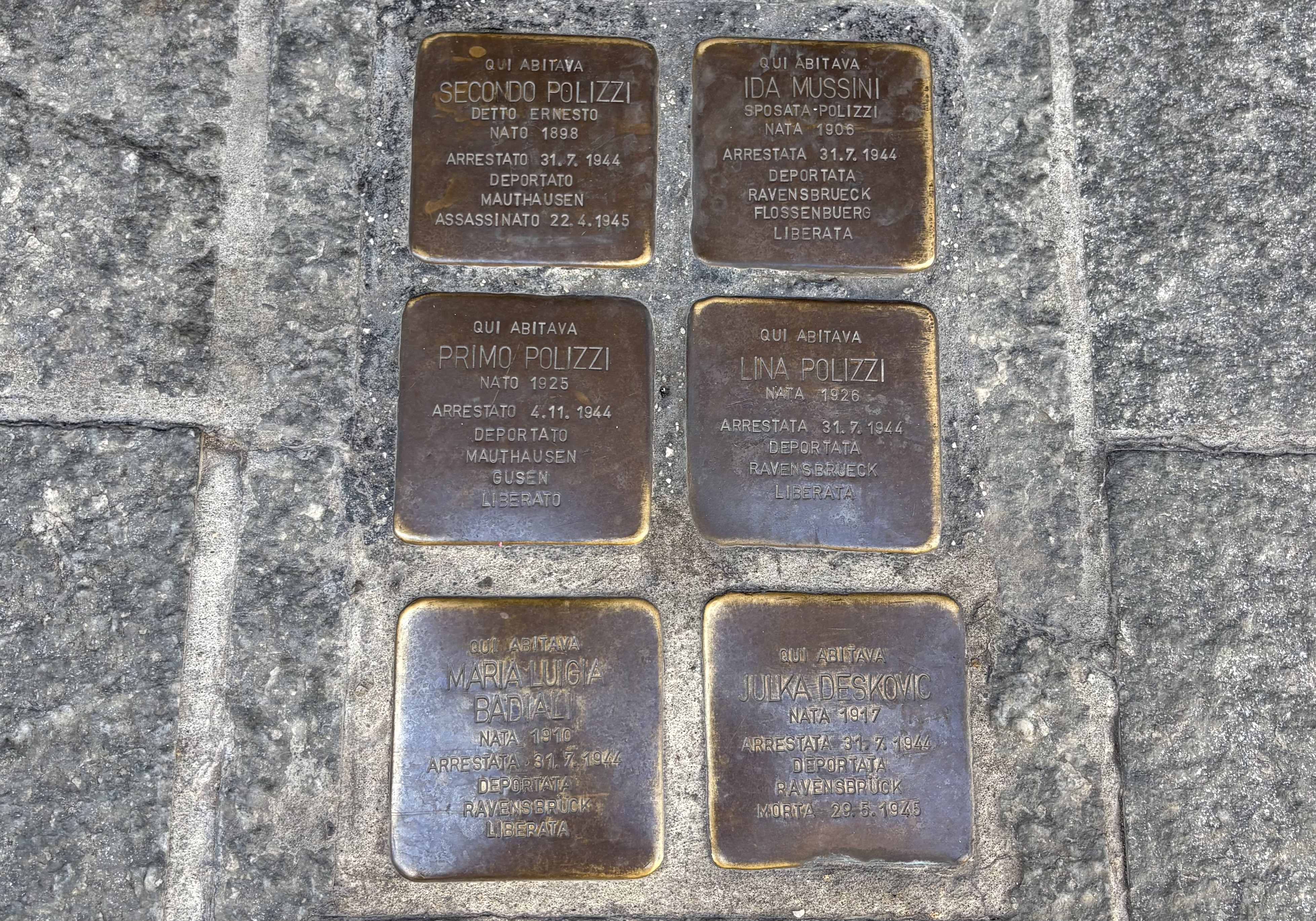
Someone used to live here: “stolperstones” are set in pavement outside homes of those deported to the Nazi killing camps of World War II. They are found all over Europe; these are located in Parma, Italy. Photo by the author.
Another holiday, another country; some of us, more privileged, may say these words in light-hearted jest, but our ancestors knew this reality as a difficult one. Last week I observed Yom Kippur within my home community in Portland Oregon, now on the other end of Sukkot I observe and remember the Shabbat and the holy day of Shemini Atzeret, and then on its heels Simkhat Torah, in Parma, Italy.
There was a Jewish community in Parma long enough ago to be blamed with exile for the Black Death. Later, having made their way back to this home, they were once again expelled, this time for incurring the resentment of their neighbors for some other reason. Not unlike other Jews in other places, at other times, for similar reasons, for different reasons, for no reason that made sense outside of local context. Truly there is no reason to hate another human being that makes sense outside of the specific context, and without the rationale afforded by it, no hate is reasonable.
The week of Sukkot can be understood as a way to experience the instability of home, no matter where we think it is, and no matter how deeply we feel we belong there. The six Jews represented by the memorial stolperstones in the above photo called Parma home; the mementos, keepsakes, and collectibles of their lives surrounded them in that place. Yet they were abruptly taken away from all that and in an instant, the only shelter they knew was whatever they could cobble together. So it is with us on Sukkot, only we are able to choose this temporary dislocation, and, weather gods willing, we can depend upon the fragile, teetering structure to be standing there for the entire week of the holy day period (duct tape is indeed a religious support in times of need).
And then, just as abruptly as the holy day period came upon us, it is now ending. From the start of Elul to Rosh HaShanah, then a Shabbat, then we steeled ourselves for the test of Yom Kippur’s fast, then there’s another Shabbat and it’s Sukkot with all the extra prayers and rituals and celebrations and then Hoshanah Rabbah, Shemini Atzeret, another Shabbat in there somewhere, and Simkhat Torah…a religious whirlwind. So much. So exhausting.
Shemini Atzeret, which means “eighth gathering” is the name of the last day of Sukkot, which is a seven day holiday which takes eight days. (Don’t ask why. Also don’t ask why the prayer Shemoneh Esreh, which means eighteen, consists of nineteen blessings.) Its purpose is unclear and our ancestors suggest that it is a way of softening the suddenness of the end of this long celebration in which we’ve all been living an altered state. Before we go back to normal life, regular routines and typical activities, let’s take one more day. It’s rather like the joke that Jews say goodbye at the end of a party but don’t leave; the best conversations often are the ones in the hallway with your coat half on. Yes it’s late, yes we’re tired, but maybe just one more minute.
Shemini Atzeret is the conversation with the coat half on, the long hugs as we realize we’re about to be parted for however long, the wait-I-almost-forgot extra time to prepare a parting gift, wrap up a leftover, have one more for the road, or take the photo to send to someone who couldn’t be there. Our tradition suggests that it’s HaShem that can’t let us go without an extra final day; if we understand the sense we share that this poignancy in advance of the absence is a universal phenomenon, then calling it HaShem makes sense. It’s a sense we share that goes beyond words and beyond individuals.
There’s never enough time together. There’s never enough time to express the gratitude and the joy of being together. This coming Shabbat will be “normal”, no extra Hallel and no once-a-year piyyutim, those special ornate poems written most famously by Eliezer Kallir that make the festival prayer services even longer, because there’s always one more word of praise, of thanks, of amazement, to lift up.
We’ll get more sleep. The etrog will become just another citron. The holiday decor will get packed away for another year. But for now, for this Shabbat, let’s take just one more day to be together.

