The famous part of this week’s parashah is at the very beginning: after weeks of build-up, the saga reaches its dramatic climax as Judah steps forward to confront the ruler of Egypt (not knowing that this ruler is his own little brother). In this single act of courage and emotional maturity, Judah breaks a tragicContinue reading “Shabbat VaYigash: How To Become Israel”
Category Archives: Uncategorized
Shabbat Miketz: light is seen only in darkness
The Shabbat of Hanukkah is nearly always Shabbat Miketz. The word miketz means “at the end of”, and in this context it refers to the end of a period of time – a dark time, with Joseph missing from his family and his home. Joseph is imprisoned in a dungeon as we begin the parashah,Continue reading “Shabbat Miketz: light is seen only in darkness”
Shabbat VaYeshev: What Do You See in the Light?
One of my favorite English lines from an old siddur is from a Kaddish meditation: “in light we see; in light we are seen.” This kind of light is not only visible, of course; illumination can also be of the “aha” kind, when something suddenly clarifies in the mind. The universal illustration for that atContinue reading “Shabbat VaYeshev: What Do You See in the Light?”
Shabbat VaYishlakh: A Personal Aliyah Moment
This week’s parashah is VaYishlakh, “he sent”. In it we find ourselves deep into the story of Jacob, the third of the Patriarchs. He has just survived a night struggle with an angel, and then a long-delayed anxious meeting with his brother Esau. In the verses just before we begin (since we are reading theContinue reading “Shabbat VaYishlakh: A Personal Aliyah Moment”
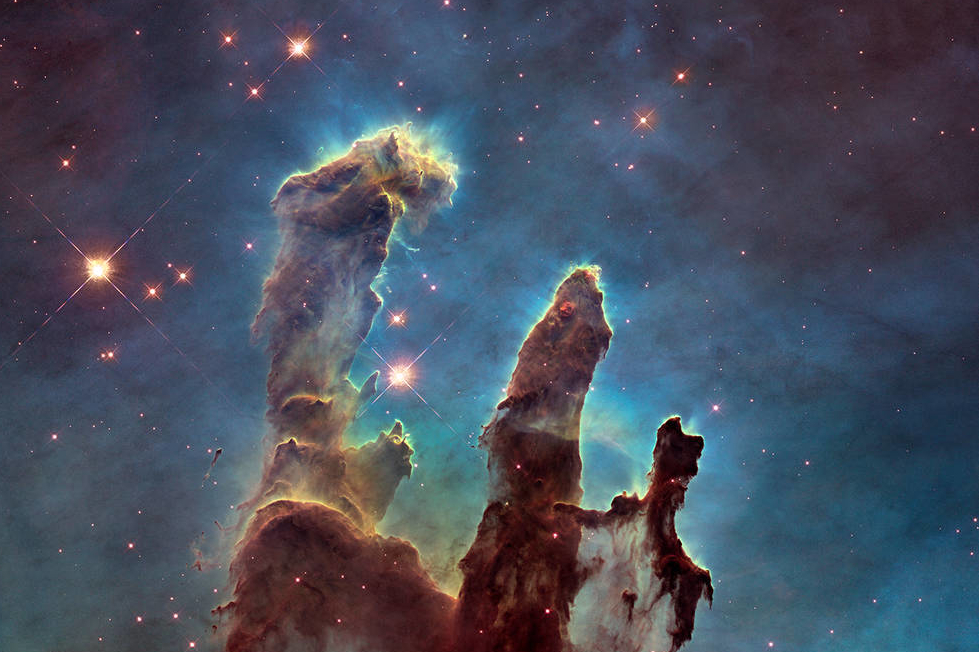
“Out of chaos He formed substance, making what is not into what is. He hewed enormous pillars out of ether that cannot be grasped.” – Sefer Yetzirah 2.6
Note the uncanny resemblance of these “enormous pillars” to the Hebrew letter shin which is used to indicate God’s protective Name Shaddai. The website Students for the Exploration and Development of Space explains: These eerie, dark pillar- like structures are actually columns of cool interstellar hydrogen gas and dust that are also incubators for newContinue reading ““Out of chaos He formed substance, making what is not into what is. He hewed enormous pillars out of ether that cannot be grasped.” – Sefer Yetzirah 2.6”
Shabbat VaYetze: Rediscovering the Power of Leah and Rachel
In this week’s parashah we read about the “baby wars” between Leah and Rachel as each try to outdo each other in giving their shared husband sons. It’s easy to dismiss as a misogynistic satire of two women fighting for their husband’s attention, but that’s only the top layer of this fascinating story. A closer lookContinue reading “Shabbat VaYetze: Rediscovering the Power of Leah and Rachel”
Shabbat Toldot: Digging Down to Rise Up
This week’s parashat hashavua describes the difficulty Isaac encounters in establishing himself in the aftermath of his father’s death. Apparently the locals do not respect him as they did his father. Isaac dug again the wells of water that were dug in the days of Abraham his father, for the Philistines had stopped them up afterContinue reading “Shabbat Toldot: Digging Down to Rise Up”
Shabbat Hayei Sarah: Live This Day As If It Is Someone Else’s Last
I believe passionately that the key to meaningful life is learning. And I am not simply offering you my personal opinion. Our Jewish tradition asserts that if we are open to learning new insights, new perspectives, new ideas all the time – even in situations that don’t seem suited to learning – we can redeemContinue reading “Shabbat Hayei Sarah: Live This Day As If It Is Someone Else’s Last”
Shabbat Lekh Lekha: Finding Light in Darkness
One of the more arresting insights about this week’s parashah is that it describes G-d’s third attempt to create a world. The first attempt ended in a terrible, world-destroying flood. The second was not as cataclysmic, since G-d had sworn never to do that again, and set a bow in the clouds as a Divine reminder. Yet theContinue reading “Shabbat Lekh Lekha: Finding Light in Darkness”
Shabbat Noakh: What Do you Do with It When It’s Broken?
The parashat hashavua for this week is Noakh, the week on which, as everybody knows, we read of the great Flood. But in year two of the Triennial Cycle, where we find ourselves this year, the flood is over: Noah has opened the window, and the dove has flown in with an olive leaf inContinue reading “Shabbat Noakh: What Do you Do with It When It’s Broken?”
 Torah for the 21st Century by Rabbi Ariel Stone