Shabbat Shelakh L’kha: There Are People Living There
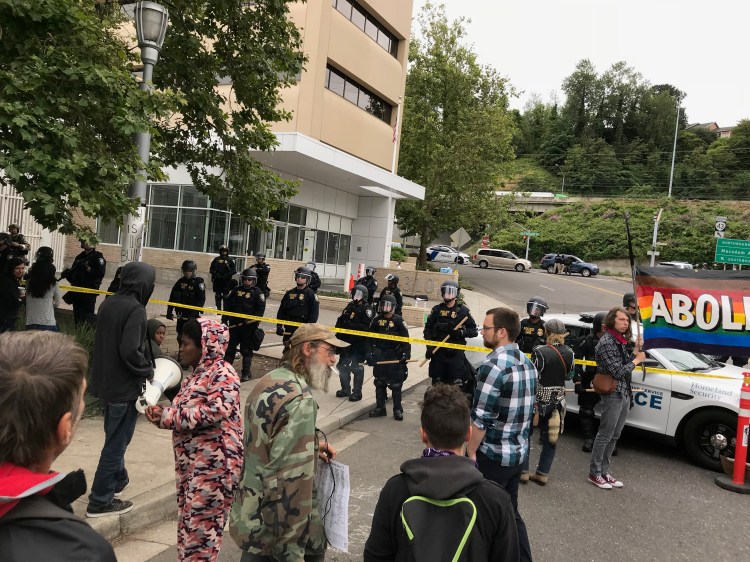
Once again, the scouts of Sh’lakh-L’kha are left holding the bag.
Every year around this time we Jews who engage in weekly Torah study again reach this story, of the moment when our ancestors stood at the verge of the land they had traveled to find, the land of their ancestral home. Scouts sent ahead to reconnoitre come back from their mission and report in. Ten of them say this: the land does indeed flow with milk and honey.
But please know this: there are people living there.
The other two scouts discount the report; in their opinion everything will be fine, if the people will only trust in G*d.
Jewish tradition blames the ten scouts for calumniating the Land, and for causing the people of Israel to doubt, and then to rebel against, the leadership that had brought them to this point. Two thousand years of commentary has piled it on: they brought bias into what should have been a neutral report. They were guilty of cowardice. They aided and abetted idolatry! In short, their honest voices are covered in loud, angry blame. The two scouts that would have us close our eyes and trust are held up as the only appropriate model.
Those of us who have come to oppose Israeli occupation of the Palestinian territory beyond the Green Line might sometimes feel like those ten scouts. Yes, we carry a difficult message, and we do get blamed, sometimes loudly, as a result. Jewish anxiety over Israel is profoundly deep, and we have good reason to fear an onslaught of anger that is out of proportion, and hurtful.
Rabbis have lost jobs, many Jews have suffered social ostracism and more, for speaking the message of the scouts aloud: there are people living there.
For rabbis, I believe that we must remember that we are ordained not rabbi for a town or a community, but “rabbi in Israel”. Of what purpose is our work if we do not honor the primary relationship we share with all the history, the people, and the land of Israel by acting with all the integrity of which we are capable? As Rabbi Israel Salantar, the founder of Musar (an early modern school of Jewish ethics), said, please pardon his gendered language, “A rabbi whose community does not disagree with him is not really a rabbi, and a rabbi who fears his community is not really a man.”
I believe it to be an essential part of my rabbinic duty to respectfully and clearly share my thoughts, concerns and hopes for Israel in ways that teach Torah. I’ve encountered rabbis who share my views but are hesitant to speak out about them to their constituencies, worried about offending anyone or failing to maintain impartiality. Yes, there will be strong and negative feelings from some, but others welcome the chance to hear more than one honest rabbinic opinion about the best way forward for our beloved Israel.
Jews with right wing views tell me that they feel a passionate responsibility to speak out for the sake of Zion. Jews with more moderate views feel that responsibility just as keenly, do they not? Further, as a citizen of the United States, I know that healthy discourse requires more than one thoughtful, caring perspective. We do ourselves and our people a disservice when we allow one viewpoint a monopoly on public opinion. My silence might lead those who hear me to believe that their only options are to be hawkish or stay silent.
We are Jews, and we must seek out Torah. We are not required to be political experts, but we should be learning every ethical Jewish text we can find about Israel, from Jeremiah, to Kamtza and bar Kamtza, to the simple Torah text that commands us to help our enemy raise the mule that has fallen under its load.
The most sensitive issues are where our learning is most needed. An end to the occupation and a peaceful resolution to the conflict are vital to safeguarding Israel’s future. We dare not allow ourselves to turn away from our people’s homeland, and so we need to re-learn, and insist upon, makhloket l’shem shamayim, the art of talking honestly, openly and respectfully about the challenges Israel faces. We can’t let raised voices deter us from our duty to guide our people in the moments when they most need our support.
For Zion’s sake I will not be silent. – Isaiah 62.1
(This d’var Torah appeared in the Times Of Israel in 2016 as an op-ed.)
Shabbat BeHa’alot’kha: Lift It Up
Shabbat Naso: Look Me In The Eye
The word that identifies this week’s Torah text is naso, part of the idiom naso et rosh, is correctly translated “take a census,” or, more simply, “count heads.” The actual Hebrew wording is more beautiful; it literally says “lift up the head.” In other words, for our ancestors, to count someone was to look that person in the eye, and to take account of that specific human being.
This parashah begins innocuously enough with a description of the work assigned to different Levite families: Kehat, Gershon, and Merar. Each family unit had a special job in connection with erecting or dismantling the Mishkan and carrying it as well. Only Levites could come this close, and they had to regularly watch to keep themselves free from tum’ah in order to fulfill this duty.
It’s as logical a segue as we will ever find that the Torah’s next subject is that of keeping the Israelites’ camp clean. Anyone experiencing tum’ah or capable of transmitting it to someone else was to be sent outside the dwelling area until the tum’ah could be cleared.
What is tum’ah? It’s a subject we come back to again and again in the Torah. We moderns come to it influenced by interpretations that call it a form of impurity (cue the caricature of the person calling “unclean!” while walking through the village). But if we meet the ancients on their ground the reality is more nuanced.
It seems likely, according to the academic scholarship on the matter, that most Israelites were tam’eh most of the time, and that was no problem since the only time one needed to be tahor (the opposite condition) was in order to take part in ceremonial aspects of Israelite ritual. To be tam’eh, then, has something to do with one’s ability – or, in this case, inability, to participate in community engaged in ritual.
You are tam’eh if you have just buried someone, or if you have just given birth, or if you experience unusual flow from your reproductive organs. You are tam’eh if you have been in the presence of someone else who is tam’eh. And, interestingly, by virtue of juxtaposition, it seems that you are tam’eh if you wrong one of the people with whom who share your community. According to our text,
When a man or woman commits any wrong toward a companion, thus breaking faith with HaShem,
and that person realizes his guilt, that person shall confess the wrong s/he has done. S/he shall make restitution in the principal amount and add one-fifth to it, giving it to the one who has been wronged. (Numbers 5.7)
Healing the situation is straightforward, the law is clear and easy, but it can only happen after a person realizes that a wrong has been committed. Until this is done, the person who committed the wrong is tam’eh, and is unable to take part in the religious activities of the community. The person wronged is unable to fully participate as well, due to the damage done to that person.
Shabbat BaMidbar and Shavuot 5778: Into The Wilderness
By three things was the Torah given: by fire, water and wilderness. By fire, as it is written (Exodus 19:18): “Now Mount Sinai was altogether on smoke, because G‑d descended upon it in fire.” By water, as it is written (Judges 4:4): “The heavens also dripped, yes, the clouds dripped water.” And by wilderness, as it is written (Numbers 1:1): “G‑d spoke to Moshe in the wilderness of Sinai.” (Midrash Rabbah)
Shabbat BeHar-BeHukotai: Love Your Mother
| וַיְדַבֵּר ה’ אֶל-מֹשֶׁה, בְּהַר סִינַי לֵאמֹר דַּבֵּר אֶל-בְּנֵי יִשְׂרָאֵל, וְאָמַרְתָּ אֲלֵהֶם, כִּי תָבֹאוּ אֶל-הָאָרֶץ, אֲשֶׁר אֲנִי נֹתֵן לָכֶם–וְשָׁבְתָה הָאָרֶץ, שַׁבָּת לה’. | HaShem spoke to Moses at Mount Sinai, saying: Speak to the People of Israel, and say unto them: When you come into the land which I give you, the land shall keep a Shabbat unto HaShem. |
Letting the land lay fallow – letting go of our need to work it, to work, to be productive, to control our future – leaving that in G*d’s hands, that is the foundation of the entire Torah, which necessitates a measure of submission to God’s will and a relinquishing control in this world. To embrace a life of Torah, one needs a measure of letting go. (from Steven Exler, The Bayit)
It means, very simply, that the entirety of our religious lives, our spiritual lives, are built upon the very physical reality of a functioning earth. None of the world of Torah gets off the ground – literally – unless the ground is healthy. We cannot do anything without an earth which is nourished, sustained, sustainable, and healthy. If we have no clean air to breathe, no clean water to drink, no clean soil to plant in, then we have no foundation in which to root – literally – our religious lives. It is a simple, basic truth: we need to take care of our earth to have a future upon it. (Steven Exler, The Bayit)
Shabbat Emor: Against the Cruelty
| וַיְדַבֵּר ה’, אֶל-מֹשֶׁה לֵּאמֹר. | HaShem spoke to Moses, saying: |
| שׁוֹר אוֹ כֶשֶׂב אוֹ-עֵז כִּי יִוָּלֵד, וְהָיָה שִׁבְעַת יָמִים תַּחַת אִמּוֹ; וּמִיּוֹם הַשְּׁמִינִי, וָהָלְאָה, יֵרָצֶה, לְקָרְבַּן אִשֶּׁה לה’. | When a calf, lamb, or kid is born, it shall be seven days with its mother; only from the eighth day on is it acceptable as an offering to HaShem. |
| וְשׁוֹר, אוֹ שֶׂה אתוֹ וְאֶת-בְּנוֹ, לֹא תִשְׁחֲטוּ בְּיוֹם אֶחָד. | Whether it be cow or ewe, you shall not kill it and its young both in one day. (VaYikra 22.26-28) |
“G*d of the Universe! You wrote in Your Torah: whether cow or ewe, do not kill mother and young in the same day.” But behold, they have murdered children and their mothers in countless number, yet you are silent!” – Ekha Rabbati
Shabbat Akharey Mot-Kedoshim: In All This Death, Where Is Holiness? Right Here at the Door
How often does Torah arouse human beings, how often does she raise her voice in every direction to awaken them! Yet they all sleep, with slumber in their sockets, neither observing nor caring….Woe to them, woe to their souls! For Torah admonishes them, saying, “Whoever is a fool let him turn aside here, the one who lacks heart.”…What is “he who lacks heart?” Rabbi Eleazar said, “Lacking faith, for one who has no faith surely lacks heart.” (from the opening commentary of the Zohar to parashat Kedoshim.)
Shabbat Tazria-Metzora: Lift Every Voice
Why does the mind so often choose to fly away at the moment the word waited for all one’s life is about to be spoken? (Alice Walker, The Temple of My Familiar)
Shabbat Shemini: Not Why. How.
Moshe said to Aaron: “Draw near the altar, and offer your sin-offering and your burnt-offering, and make atonement for yourself and for the people; present the offering of the people, and make atonement for them as HaShem commands.” (Lev. 9.7)
Nadav and Avihu, the sons of Aaron, each took his censer, and laid fire and incense on it, and offered this strange fire before HaShem, which had not been commanded. And there came forth fire from before Hashem and consumed them, and they died before HaShem. (Lev. 10.1-2)