The word that identifies this week’s Torah text is naso, part of the idiom naso et rosh, is correctly translated “take a census,” or, more simply, “count heads.” The actual Hebrew wording is more beautiful; it literally says “lift up the head.” In other words, for our ancestors, to count someone was to look that person in the eye, and to take account of that specific human being.
This parashah begins innocuously enough with a description of the work assigned to different Levite families: Kehat, Gershon, and Merar. Each family unit had a special job in connection with erecting or dismantling the Mishkan and carrying it as well. Only Levites could come this close, and they had to regularly watch to keep themselves free from tum’ah in order to fulfill this duty.
It’s as logical a segue as we will ever find that the Torah’s next subject is that of keeping the Israelites’ camp clean. Anyone experiencing tum’ah or capable of transmitting it to someone else was to be sent outside the dwelling area until the tum’ah could be cleared.
What is tum’ah? It’s a subject we come back to again and again in the Torah. We moderns come to it influenced by interpretations that call it a form of impurity (cue the caricature of the person calling “unclean!” while walking through the village). But if we meet the ancients on their ground the reality is more nuanced.
It seems likely, according to the academic scholarship on the matter, that most Israelites were tam’eh most of the time, and that was no problem since the only time one needed to be tahor (the opposite condition) was in order to take part in ceremonial aspects of Israelite ritual. To be tam’eh, then, has something to do with one’s ability – or, in this case, inability, to participate in community engaged in ritual.
You are tam’eh if you have just buried someone, or if you have just given birth, or if you experience unusual flow from your reproductive organs. You are tam’eh if you have been in the presence of someone else who is tam’eh. And, interestingly, by virtue of juxtaposition, it seems that you are tam’eh if you wrong one of the people with whom who share your community. According to our text,
When a man or woman commits any wrong toward a companion, thus breaking faith with HaShem,
The next case brought by the Torah – and we are still informed by the principle of juxtaposition, which indicates that this is somehow related to what just came before – this next case describes the situation in which any one of us has wronged another in our community. Note that to do so is much more than simply wronging a fellow human; the Torah insists that to wrong the other in our midst is to ‘מעל בה – literally, to betray HaShem. This is an utterly powerful statement. To wrong another person is to wrong G*d.
It’s interesting to note that here, as in every other case of tum’ah, nothing can be done about it until the state of being – the tum’ah – is recognized. As the verse goes on:
and that person realizes his guilt, that person shall confess the wrong s/he has done. S/he shall make restitution in the principal amount and add one-fifth to it, giving it to the one who has been wronged. (Numbers 5.7)
Healing the situation is straightforward, the law is clear and easy, but it can only happen after a person realizes that a wrong has been committed. Until this is done, the person who committed the wrong is tam’eh, and is unable to take part in the religious activities of the community. The person wronged is unable to fully participate as well, due to the damage done to that person.
What would our communities be like if we were as careful to sweep tum’ah from, as it were, the midst of our camps, by focusing upon, and righting, the wrongs done among us, each to each other?
Would our U.S. community be required to pay reparations – the value plus one-fifth – to all wronged by our government’s policies – African Americans enslaved, Native Americans slaughtered and robbed, the stranger among us persecuted and oppressed?
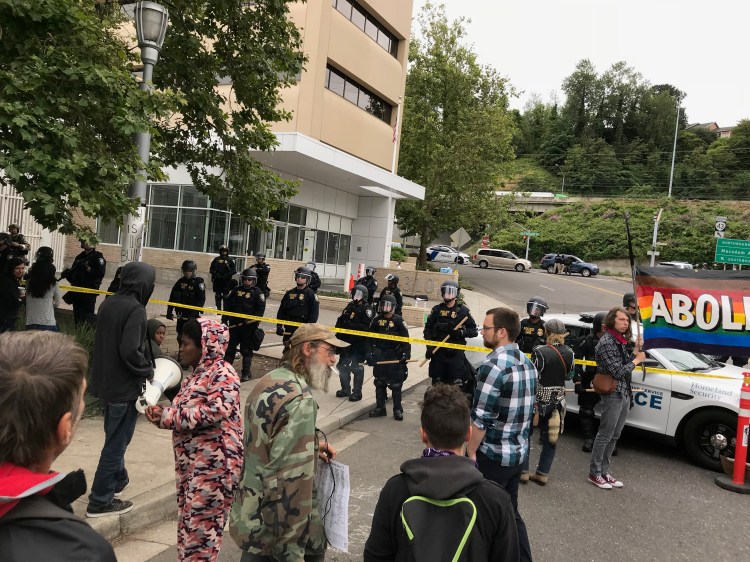
Would our Portland community be required to readjust budgets and future planning to pave streets in poor neighborhoods, restore the potential of innocents punished as guilty and people of color sidelined, repair the lives of the marginalized people that should have been protected and served?
What would our own community need to do? How can any of us discern whether we have wronged another in our midst, thus driving the Presence of G*d from us? The way our parashah urges us to take is here in the opening verse: look into the eyes of our companions and really see them, in the sense taught to us by the Jewish philosopher Martin Buber: to see the other as a presence, deserving of our respect and attention, not a projection of ourselves who ought to already understand us.
Here is one act: our congregation has endorsed a national Jewish campaign to stand up for Trans people at this time of vulnerability for our Trans sisters and brothers. Take a look at all you can join in learning and doing in support of righting this wrong, and sweeping this
tum’ah out of our midst:
Kavod Akhshav: Dignity for Trans Youth. May it bring the Presence of G*d closer to us all.
On this Shabbat, in a world in which so many are wronged, where the earth itself is crying out its pain, consider that real caring community starts among us, and begins when we lift up our own heads to meet each other’s eyes, so that each of us can say to the other, here, come in: sit down. Share my bread and wine. Let us walk together. Only then can we begin to let down our protective walls and be seen, and only then can we truly see each other. That’s the clean, safe, happy camp the Israelites were trying to create. May we learn to live so in our own days, and may we understand that it is the first step toward the better world we pray for.

 Torah for the 21st Century by Rabbi Ariel Stone