
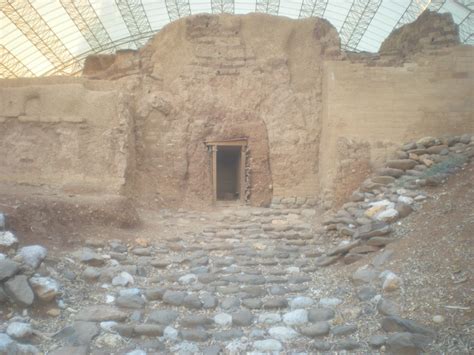
ancient wall with gateway at Tel Dan, northern Galilee
_______________________________________________________
doing the same thing over and over gets old after a while, so we take a break. Is that all there is to the acts of our lives, and the work of our hands?
In their wisdom, our ancestors understood that human nature is changeable; a good thing, yes, until you are called upon to establish a regular routine that you will maintain throughout your entire life.
Entire life? Other than the necessities of physical existence, what could possibly be that deeply rooted in an individual’s life?
If it is difficult for you to imagine such a routine, you are experiencing the limits of life envisioned as individual, answerable to no one but oneself. The plus side of such radical individualism is that no one is the boss of you – of which you consciously are aware, at least. The negative side is that whatever you are doing has no deeper meaning than that you’ve chosen to do it today. No group expectation, and no group support.
Informally, we speak of anything that we do without fail to be something we do religiously. There’s something to that, as it turns out. Our ancestors, the Rabbis who inherited the civilization of ancient Israel, discerned daily obligatory acts for us to individually take, and for which we would be individually judged, but that mostly – if not all – depend upon a community within which the acts take place.
That is the reason that the grammar changes from individual to plural in the first verse of this week’s parashat hashavua. “You” (singular) for “your” (plural) tribes.
שֹׁפְטִ֣ים וְשֹֽׁטְרִ֗ים תִּֽתֶּן־לְךָ֙ בְּכׇל־שְׁעָרֶ֔יךָ אֲשֶׁ֨ר ה’ אֱלֹהֶ֛-ךָ נֹתֵ֥ן לְךָ֖ לִשְׁבָטֶ֑יךָ וְשָׁפְט֥וּ אֶת־הָעָ֖ם מִשְׁפַּט־צֶֽדֶק׃
You shall appoint magistrates and officials for your tribes, in all the settlements that your G*d ‘ה is giving you, and they shall govern the people with due justice. (Deut. 16.18)
These obligatory acts are called mitzvot. A word that is often mistranslated “good deed”, it actually means obligation, or command, or order. Some are daily, some weekly, some once a year; some you will never encounter unless you are a shepherd or farmer living in Biblical Israel while the Temple stood and the sacrificial system functioned.
The post-modern Western world offers us a narrative for our lives in which everything depends upon the invidual’s choice, and act. It is a way of life completely different from the narrative we took for granted only a thousand years ago, and certainly at the time that the idea of mitzvot was discerned.
Yet the Torah still speaks to us because human nature has not changed; we can see ourselves, and relate easily enough, to the shenanigans as well as the angst and challenges of the personalities chronicled in the ancient texts. If we are not really that different, perhaps our lives are missing a level if we are unaware of the ways in which we are connected to each other – the ways in which our singular is addressed as part of a plural to which we belong.
A Jew can live a shallow life as a citizen of the U.S. or any other nation in which we find ourselves, and move without reference to other Jews. One is free of the expectation of mitzvot in that case – and “freed” of the opportunity to experience what story might inform one’s life on the day that the narrative one makes up as one goes along comes up short. Curiously, enough, to be less free of the expectations and needs and complications of others in one’s life might actually mean that one is less free to live one’s life completely.
To be a Jew is to have a door into more life open to you always, no matter what choices you have made until this day. It’s the door into Jewish community, wherever and however you find it – and let it find you.
The Door of Hope is still open.
Things are not what they might be.
We still believe, or many of us do, what the Exodus first taught:
first, that wherever you live, it is probably Egypt.
second, that there is a better place, a world more attractive, a
promised land.
and third, that “the way to the land is through the wilderness.”
There is no way to get from here to there
Except by joining together and marching.
– Michael Walzer, Exodus and Revolution

