Shabbat Akharei Mot-Kedoshim: The Goal of Torah Study

This week’s parashah is once again a double: Akharei Mot, “after death” and Kedoshim, “set apart”, which is what “holy” means in Jewish religious culture. 

Because every couple of years these two parashot occur as a double (meaning that we read at least a third of them both), it was only natural that our inquisitive and creative Sages who comment upon and interpret every aspect of Torah should comment upon this too: what do we learn from the juxtaposition of these two parshas, and their names? Are we to understand that after death we are holy? what exactly would that mean?

It’s not a stretch for us to accept the idea that the memory of our beloved dead is holy to us, that is, it is set apart in our hearts in a special place, so to speak. We might even set that memory apart to recall only at special times, such as yizkor, the memorial prayers we recite four times a year (at the Festivals and on Yom Kippur). 

When we pause to consider the place of death in Jewish tradition, we discover that other aspects of holiness may come into play. For example, we read in the Talmud that after the Roman massacre of Jews at Betar, we were not allowed to bury the bodies – in this final battle of the third failed Jewish revolt against Rome, they were to be a terrible lesson to the rest of us. The Talmud asserts that years later when we were able to bury the bodies, they had – miraculously – not decayed. This idea of a miraculous preservation is later expressed in connection with a belief in what happened (or didn’t) to the dead bodies of tzaddikim, “righteous ones”, such as great Rabbis. These bodies have become different, set apart in our religious tradition, and therefore, in a way, holy.

But does death itself connote holiness? A dead body carries the quality of making all that come into contact with it tamei, “spiritually unready” to stand in G-d’s presence. It causes one to be “set apart” in that way, and such a one must undergo a ritual process in order to become once again tahor,  “spiritually ready”, or what we might call normal, as afterward one does return to normal life.

The place of death in our lives is alternately problematic, fearful, tragic, and inevitable – and sometimes even a blessing. All of us will face it. The Jewish question is how does Jewish learning help me face it? Torah study is able to follow us everywhere. The question is whether we let it in.

Aryeh Ben David, writing for eJewishphilanthropy on February 11, 2015, notes that Jewish learning has been conceptualized as having two primary foci.  Now, he suggests, it’s time for a third.  The first stage of Jewish learning asked the question – “What do I know?” The second stage of Jewish learning asked the question – “Am I connected to what I know?” 

He writes:

The third stage of Jewish learning asks “How can I bring my learning into my life? How does what I know and my personal connection to this knowledge change me? How is Jewish learning making me a better person?”

2,000 years ago, Judaism instituted the reciting of blessings before eating. The goal of saying a blessing is not only to know the words and meaning of the blessing. The goal of saying the blessing is not only to feel connected to the words of the blessing. The goal of the blessing is ultimately to affect me and transform how I eat.

The test of saying a blessing is whether it changes how I actually eat.

Similarly, the goal of learning Torah is not only to know content, and not only to be connected to what I know.

The test of learning Torah is whether it changes how I actually live.

http://ejewishphilanthropy.com/the-third-stage-of-jewish-education/?utm_source=Feb+11+Wed&utm_campaign=Wed+Feb+11&utm_medium=email

May your learning change your life and all that touches it for good.

Shabbat Tazria-Metzora: Time Out

This week’s double parashah reflects a fundamental understanding of ancient Israelite religion – and we are not sure that we know what it is. Between parashat Tazria and parashat Metzora, we are presented for four solid chapters of VaYikra (Leviticus) with rules of what anthropologist Mary Douglas called “purity and danger” in her book of the same name.

The guidance presented by Torah in these verses (12.1-15.33) separates the tamey from the tahor, two categories that are unhelpfully translated as “pure” and “impure” when in truth the situation is more complicated than that. In her examination of the religious laws which include this as well that other famous duality of Jewish law (kosher or not), Douglas insists that we regard these ideas not with the dismissive superiority of moderns but with what I like to think of as a post-modern curiosity about that which is not yet understood. These ideas should be approached as “a shorthand summary of the categories of Israelite culture….taken as a whole and related to the totality of symbolic structures organizing the universe.” (Douglas, Natural Symbols, 60). 

At a glance, even the most casual, it is not difficult to detect the ancient Israelites’ desire to keep the world ordered and coherent. One is always in either a state of being which is tamey or tahor. The activities and situations which cause one to be tamey are neither bad nor to be avoided, and they are not associated with sin. They include birth, death, sex, and food, among other basics of human life.

Most interesting is the requirement for “time out” in between the two states of being. For example: if one is in a state of being tamey because one has been ill with a contagious disease, one is required, for the good of the community, to be isolated for a specific time. When one is no longer showing signs, one is expected to return to one’s former place. In other parts of VaYikra the same rule applies to one who has been in the presence of death: one takes time away from the community, and then returns to one’s “normal” social existence. 

One of the great gifts of Jewish tradition is its insistence that we take time to recover from our experiences, and that certain situations carry certain ordered and religiously-mandated responses. Since the effect of illness or grief is often to cause us to feel isolated, there is a simple logic to the ancient Israelites’ understanding that the sense of isolation might be acted out and respected. One is given a specific pattern of behaviors to follow to help one move through the experience, and its aftermath. 

Since at the end of the “time out”, the Israelite is once again able to enter the sacred grounds and stand before G-d, we might understand one possible interpretation of the terms tamey and tahor to be “spiritually unready” and “spiritually ready”. Certainly we all feel the need sometimes to “take a break” from the community’s expectations of us – that might be our time of spiritual unreadiness. If so, what might be a relevant way for we moderns to move through the experience so that we can return to “normal”, and our beloved companions on our journey? Our ancestors went off alone into the wilderness (or at least a short walk away from camp); how can you in your own life make space for yourself so that your spiritual unreadiness is respected, moved through, and made ready?

Shabbat shalom,

Rabbi Ariel

Shabbat haGadol: Preparing for Today

This is the last Shabbat before we leave. Grab what you think you can take with you, we have no idea, really, what we’ll be facing, only that we’re leaving.

בכל דור ודור חייב אד לראות את עצמו כאילו הוא יצא ממצרים . In every generation, each person is obligated to see himself as if he went out of Egypt.  (Mishnah Pesakhim 10:5)

This mitzvah, this obligation, is at the heart of our celebration of Pesakh, the Festival of Matzah. And on this last Shabbat before Pesakh we are to prepare, and to help each other to prepare. But here’s the paradox: the moment itself, should we reach it (may we reach it in peace!), will be something we cannot be prepared for.

How shall we be prepared for that which we cannot prepare for? The regular parashah this week, parashat Tzav, holds a clue to the answer. Among the directions for maintaining the newly established sacrificial system we find the following:

  אֵשׁ, תָּמִיד תּוּקַד עַל-הַמִּזְבֵּחַ–לֹא תִכְבֶּה.

Fire shall be kept alight upon the altar continually; it shall not go out. (Lev. 6.6)

We find that the Jerusalem Talmud comments, “continually—even on Shabbat; continually—even in a state of spiritual unreadiness.” (PT Yoma 4.6)

In a very real way, this is still our daily work: to keep the fire burning. The mystics teach that every aspect of the physical Sanctuary has its counterpart in the inward Sanctuary, within the soul of the Jew. Your heart, they teach, is that altar. Our most important task is to keep the fire – of passion, of love, of joy – burning. 

How do you prepare for the unknown that Pesakh commands us to face? by keeping your inner fire bright. That which you do to take care of that inner fire – even on Shabbat, even when you are distracted, bored, not “spiritually ready” – that will keep you prepared, even for that which you cannot imagine in your future.

In this context we note that the name here for the continually burning fire is eysh tamid, from which we get the ner tamid, that light in every Jewish sanctuary which is misunderstood as the Eternal Light. The only thing eternal about it is the regular daily dedication of those who were tasked with keeping it going, regularly, all the time! Once that was the priests on behalf of us all, but since the Jerusalem Temple was destroyed, we act according to the Torah’s teaching that “you shall be to Me a kingdom of priests and a holy people” (Exodus 19.6). We are all priests now, and that fire’s regular light depends upon all of us to keep it going, not only for ourselves but for each other.

The Talmud records the teaching: “the one who has enough to eat today and worries about tomorrow has no faith.” (BT Eruvin 54a) This is not meant to encourage you against future planning – only to understand that essentially we cannot control tomorrow, but we can act upon today. Especially upon ourselves. Worry about yourself today, the Sages suggest, and you need not fear tomorrow. Keep that fire going for today. One day at a time. Right now.

Shalom Shir Tikvah Learning Community,

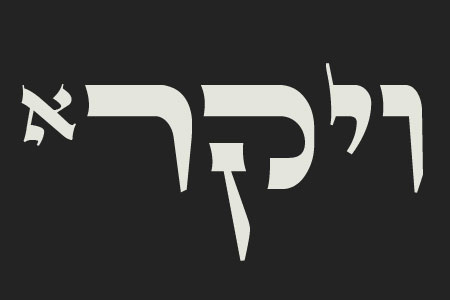
We have begun reading from the third book of the Torah in our ritual cycle; the book VaYikra, translated as “Leviticus”. The word refers to all things priestly, literally, of the Levites. It gives precise instructions for how the ancient sacrificial cult was to be enacted, and probably was originally meant only for the priests, as a sort of manual.

Sacrifice – killing animals in a ritual way, offering them up along with grain, wine and water (with incense and salt added) – here is a whole swath of Torah that seems so far beyond relevance for us today. 

Yet the Jewish dance with Torah is a committed one; we continue to hold on even when the steps aren’t so certain. As Martin Buber taught, we who are covenanted with G-d see the Torah as our ketubah. We are always to accord it the same respect that we would a human interlocutor. That is to say, we do not decide in advance if the person speaking to us will offer words worth considering. Rather, we grant that courtesy in advance, for the sake of authentic communication. In the same way, with every verse, we give Torah credit for having something to say to us that is worth hearing, and keep our minds and hearts open for what it might be.

We begin to bring the conversation out of obsolescence and into provocative territory simply by noting the Hebrew name of the book. VaYikra, “And he called out.” This is the first word of the narrative, yet unlike in good English grammar, there is no named subject, no definition of “he”. One must go back to the preceding words, at the end of the book Shemot (Exodus), to find the referent. It is G-d, calling from the newly-built sacred space that the Israelites just spent the last few parshas constructing. 

The lack of clarity here invites us in; it is not so clear what is summoning or to whom, and so we can ask ourselves; in what way does this apply to me? what, for example, summons me, even if I am not entirely clear yet about it? What is it that pulls at us so softly that we cannot quite name it?

Jewish tradition offers us a way to listen more closely to that which summons us. It comes from an interesting aspect of this very first word. As written in the Torah, the last letter is too small: 

vaykro
That first letter, the alef, sits there and says to us darsheni, “interpret me!” And so we consider: the first letter is first, which connotes importance, even centrality; it is not a surprise, then, that the alef is the first letter of the word you need to express yourself, your “I”: ani.  This letter’s place in the initial word of the book VaYikra can be seen to offer us a lesson all by its small self. It is the insight taught by the mystics: if you want to experience G-d, get your “I” out of the way.

When you feel that uncertain something, that invitation to consider not what is but what might be if you are ready to contemplate a new learning, don’t let your “I” stop you. It will say “I don’t believe” or “I don’t want to change” or “I already understand” or even “I have a right to….” 

This first word of the book that calls out is calling out to you not to let surface strangeness put you off. It is not dangerous to corral your “I” (a mystical practice called tzimtzum, voluntary contraction of the self) when you do it from a place of choice. And when you do it, leaving defenses behind and making room for that summons, the word VaYikra hints at what you might find – something very yakar, “precious”. And if not a certain finding, certainly a sense of something pulling you toward what might be, yet, to learn.

Getting Ready for Pesakh: What Is Matzah Really About?

It’s all about the matzah. The official name – and the  most ancient name – of our early spring festival is Hag haMatzot, the Festival of Matzah. Eating matzah is a mitzvah, an obligation for every Jew.

But what if you’re gluten free? this question has of course already been answered by the matzah industry: along with all the other varieties, there is gluten-free matzah. 

But this answer is too quick; it doesn’t give us the chance to really consider the question of why we are obligated to eat matzah in the first place. After all, we are forbidden the five grains wheat, barley, spelt, rye and oats. but we can eat them in a matzah state, so the grains themselves are not forbidden….or what?

The answer is not about food at all, but about our illusion of control over our lives. Why matzah, i.e. unleavened bread, bread that is entirely untouched by the natural or introduced presence of yeast? 

Our ancestors lived and died by the amount of grain they were able to grow, gather and store by the hard work of their own hands. One can imagine the care they took in storing grain so that it would last as long as possible without fermenting, which after all is the first step in rotting.

And now imagine a festival which is marked by the cleaning out of all the old grain – even before all the new grain is gathered in. This is our ancestors’ ultimate leap of faith – to clean out the old before the new was a sure thing was to demonstrate with their lives and that of their families that they trusted the old Jewish idea that if you take great care with today, tomorrow you will be all right. 

Note the interesting verb tashbitu in the verse: 

שִׁבְעַת יָמִים, מַצּוֹת תֹּאכֵלוּ–אַךְ בַּיּוֹם הָרִאשׁוֹן, תַּשְׁבִּיתוּ שְּׂאֹר מִבָּתֵּיכֶם:  כִּי כָּל-אֹכֵל חָמֵץ, וְנִכְרְתָה הַנֶּפֶשׁ הַהִוא מִיִּשְׂרָאֵל–מִיּוֹם הָרִאשֹׁן, עַד-יוֹם הַשְּׁבִעִי.

“Eat matzah for seven days – on the first day, tashbitu the grain from your houses. Anyone who eats hametz from the first day until the seventh day will be cut off from Israel.” – Exodus 12.8

The root of tashbitu is sh.b.t. This hint of Shabbat is possibly meant to remind us that we are not in control; that you can store up all you want against life’s contingencies, and you are not, after all, going to be able to control them.

The eating of matzah is a positive obligation; that is, it is not about avoiding something, it is about doing something. In this case, eating matzah. That is why, even if you are gluten-free, it is incumbent upon you to do so. There is something profoundly symbolic about it, so much so that if you do not, you cause yourself to be alienated from the People of Israel. You do not have to eat matzah all week; just an amount equal to the volume of an olive. If you absolutely cannot eat even that small amount, it’s best to get together with others who are truly gluten averse and 

invest together in one box of that expensive gluten free matzah – one more way to demonstrate our absolute need for each other, and the reason why the idea of being cut off from Israel is the worst outcome our ancestors could possibly envision

Shabbat Ki Tisa: Thinking Outside Your Self

This is the Shabbat of parashat Ki Tisa, the most famous part of which is the debacle of the Golden Calf. On one foot (the Jewish idiom for “in a nutshell”): We have just lived through the glorious commitment ceremony between us and G-d, and received the promise of the Torah (at least the Aseret haDibrot, the “Ten Utterances”) as our ketubah. We begin to build a sacred space to celebrate that relationship and seek its intimacy. Then Moshe goes up to Mt Sinai to get the Torah from G-d – and there our troubles begin.

According to the midrash, it was all due to a misunderstanding:

When Moses ascended the mountain, he said to them: After forty days, in the first six hours of the day, I shall return. They thought that the day of his ascent should be counted as one of the forty, while he meant forty full, 24-hour days. In truth, the day of his ascent – Sivan 7 – should not have been counted, since it did not include its previous night, meaning that the forty days ended on Tammuz 17.

On the 16th of Tammuz the satan came and filled the world with darkness and confusion. Said he to them: “Where is your teacher Moses?” “He has ascended on high,” they answered him. “The sixth hour has come,” said he to them, but they disregarded him. “He is dead”–but they disregarded him. So the satan showed them a vision of Moses’ bier. This is what they said to Aaron, “For this man Moses, who brought us up out of the land of Egypt, we know not what is become of him.”   (Rashi; Talmud, Shabbat 89a).

The appearance of the satan in this story is fascinating, because in Jewish midrashic tradition, the satan is expressed as that which sabotages the relationship of the Jewish people with G-d, or between two Jews. In this story, the satan does nothing creative to bring about the disaster of the Golden Calf – it simply amplifies and “tempts” into hysteria something that is already there.

What could have caused our people to stray so utterly, and commit so painful a betrayal, so quickly after the joyous Sinai moment of “we will do and we will hear”? Perhaps it was really nothing more than letting themselves get caught up in a never-ending loop of mutual concern, which turned into escalating fear, which turned into catastrophic fantasy – thus we might all find ourselves falling down a big, black rabbit hole of our own making and without any reality other than that of our own, utterly unfounded conviction.

It’s too bad that they could not hear Aaron trying to tell them: there’s nothing wrong with Moshe; he’s on his way. All you’ve done is get nervous and mistake the time.

Where does the satan come to amplify your own fears or misgivings, and turn them into a stumbling block before which no good intention can possibly get through to you? Is it a feeling that you haven’t been heard, when if you checked you’d find out you had? Is it an ill-considered desire for your own definition of perfection that gets in the way of the communal good? If it keeps you away from G-d and feeling distanced from those with whom you share community, then maybe you need to try thinking outside yourself and your own, already formed convictions. Maybe you are wrong. Maybe there’s another perspective. Maybe you need to open your heart and listen.

The wonderful thing about community is the trust we are offered, and the chance to turn to someone and say “please check my thinking here”. Where one may be lost in the dark, two or more have a better chance of finding the light again.

Shabbat Zakhor: What Commands You to Remember?

This Shabbat is not only named Tetzaveh, “you shall command” for the Torah reading assigned to it, but also Zakhor, for the imperative “remember!” which denotes the special Torah reading added to the regular weekly parashah. This is the second of four special Shabbatot that mark the days we count down (or, more appropriately, up) to Pesakh, the “Festival of Matzot”.

The meaning of the counting is mindfulness, in its own way a form of remembering: as we near one of the most significant moments in the Jewish calendar, special Haftarah readings emphasize certain themes which help us notice, and be aware of the time passing.

The meaning of counting “up” (instead of down, the usual idiom) refers to the Jewish teaching that we always add to holiness, and never take away. That’s why we light one candle on the first night of Hanukkah and add a light each night (it is at least just as logical to start with eight and take one away each night, since we are remembering a certain amount of dedicated oil, which was reduced each day). Upward and onward, so to speak.

The four special Shabbatot (they are compared to the Seder’s Four Cups of Wine) can be seen as invitations upward, one Shabbat at a time. The first is Shabbat Shekalim, on which we take note of our financial condition as we near the Jewish calendar’s New Year (Pesakh takes place during the month of Nisan, which is the first month of the Jewish calendar); we make adjustments, and get ready to pay taxes and give tzedakah as we are expected to do. The third, Shabbat Parah, describes the conditions for spiritual readiness (“ritual purity”) required to prepare oneself for the Seder. The fourth, Shabbat haHodesh, “the Month”, proclaims the beginning of Nisan: it’s time to prepare your Seder.

Then there is this Shabbat, the second one of the series, called Shabbat Zakhor. It calls upon us to “remember!” The question is, remember what? And how is memory a move upward, toward a more complete spiritual readiness, and openness?

Memory, it turns out, has always been a primary requirement for spiritual readiness among our people. Our ancestors, we are told, traveled up to Jerusalem to celebrate this Festival in the ancient past. When they reached the top of this physical and spiritual aliyah (going up) they were promised that they would all be able to actually see the Face of G-d, as long as they brought their zakhur with them – their memory.

What does it mean to see the Face of G-d via memory? To consider this question we have to be willing to put down a lot of assumptions, for example: 

1. that G-d is a sort of manipulative Wizard of Oz

2. that G-d has a face the way a human being does

3. that our ancestors were qualitatively less intelligent than we are in matters spiritual

If you are able to reject these Jewishly unfounded imaginings, then consider: the Hebrew word that most directly refers to G-d is nothing less than the letters that indicate the Hebrew verb “to be” in all its tenses; past, present, future – and imperative. Was, Is, Will Be, Be! The Jewish G-d is best (though badly) evoked through the ideas of endless time (Eternity) and endless space (Everywhere). And we share in all of it. The only issue is whether we remember that. Abraham Joshua Heschel once defined the human being as “a messenger who forgot the message”.

Remember where you come from. Let that memory carry you back, before your own individual being in time and space. And in your mind’s reaching, you will begin to be able to envision a hint of that endless eternity of which you are a small, momentary utterance, part of all being and its warp and woof, utterly necessary and completely at home. 

Remember, and let that remembering move you upward, and onward, toward the you that you are yet meant to be, step by step, Shabbat by Shabbat.

Shabbat Terumah: Making a Place for God

We have left Egypt, and at the foot of Mt. Sinai we have witnessed a great and ineffable moment of connection with That Which Cannot Be Named, and which nevertheless worked to link all of us together with certainty in that mystery. We were going forward together, as a people.

But not yet. In this week’s parashah, we are still camped at Sinai, in the days and weeks after the climactic moments of awe and exhilaration. Now what? It is clear that the world is different, is newly-begun; what is not so clear yet is the way in which we will move into it.

Somehow, the impetus to build a holy place came forth from that time. It is interesting to consider what it means to call a place holy.

There are some awesome holy places in the world, places built specifically so that we could seek G-d’s presence. There are cathedrals, temples, mosques, and, of course, shuls. This past week I was privileged to encounter the heiau, the Hawaiian holy place, and to learn about its construction. A heiau is constructed of lava rocks, some of them quite dense and heavy, which are moved great distances by human chains, people handing the rocks from one to the next, hundreds and even thousands of people all working together. A heiau can measure as much as 140 by 180 feet and be 30 feet high. That’s a lot of rocks, and even more coordinated action bringing together a huge number of people.

All communal holy places seem to have this in common: it takes many people to create one. As our parashat hashavua puts it, every member of the Israelite community is called upon to participate, to bring a terumah, an offering of that which they are and which they have to give. There is work for all, with only one requirement: “all whose hearts so move them.” (Exodus 25.2) 

Our hearts have to be in the work, or it can’t be holy. In other words, there many be many shuls, churches, temples, and mosques which are glorious and grand, but unless we are all involved in the building, and our hearts are truly in it, it won’t be a holy place. We can’t all carry heavy rocks, and not all of us can design a Sukkah that will stay up a week, much less a shul, but all of us have the gift of our joy and intention.

“Where is G-d?” the Kotzker Rebbe was once asked. “Where?” he replied, “wherever you let G-d in.”

What are you involved in building in your life? a project, a program, a kitchen remodel? On this Shabbat consider: even as a shul is not a holy place unless our hearts are in it, so also, in every place in which you are truly there with an open heart, that place is holy. And then you will understand the insight of the Shelah, Rabbi Isaiah Horowitz (called the Shelah after the acronym of the name of his most well-known book of Torah commentary, the Shnei Lukhot HaBrit):

They shall make for Me a sanctuary, and I will dwell amidst them (25:8)

The verse does not say, “and I will dwell within it,” but “and I will dwell within them”–within each and every one of them. (the Shelah)

Shabbat Yitro: What Do You Hear When You Hear the Voice of G-d?

What do you hear when you are in the presence of that which matters most? This week we read of G-d’s gift of the Aseret haDibrot, the “Ten Utterances”, to the People of Israel. The Torah text describes thunder and lightning, fire and smoke, on top of Mt. Sinai. But the midrash, teachings of the ancient Sages that lead us beyond the surface level of text toward a deeper understanding of what actually happened, suggests that

in that hour the world was completely silent. No one dared to breathe. No bird sang, no ox lowed, the sea did not roar, and no creature uttered a sound….Then G-d spoke…  (Midrash Aseret haDibrot to Ex.20.2)

Consider the way the world goes silent when you are truly shocked out of your normal self by an experience; everything seems to slow down, sound recedes, and you are left in the enormity of the moment. Nothing is as you expected. It is precisely in this moment that we are capable of seeing that which we cannot see because we have never seen it before. 

This is what Jewish tradition calls “revelation”, and this is the essential Jewish revelatory moment. Although this is a communal experience (we all stood at Sinai together), there is something very personal about it. The Rabbis of the Talmud even suggest that:

every single word that went forth from the Omnipotent was split up into seventy languages. The School of R. Ishmael taught: Like a hammer that breaks the rock in pieces: just as a hammer is divided into many sparks, so every single word that went forth from the Holy Blessed One split up into seventy languages.  (Talmud Bavli, Shabbat 88b)

Rabbinic commentary suggests that we actually heard very little at Sinai, that it is not possible, after all, for human ears and brains to process something as awesomely Other as the Voice of G-d; if there is such a thing, we are going to be the last to identify it. The choice in the animated movie “Prince of Egypt” to convey G-d’s voice as that of the actor playing Moshe was a way of saying exactly that – we cannot really hear G-d’s voice, but we can hear something in our own hearts and minds that may be an echo of it.

What did the People of Israel really hear at Sinai? It is a question that continues to occupy the commentaries for generations. What seems quite clear from all the commentary is that these oral utterances were heard differently by different Israelites – which is, after all, our own experience, even as the words have long been written down, which might seem to narrow the possible interpretations.

It does not. Each of us stands at Sinai in our own way, and proof of this is in the way each of us responds to a moment in which we feel the Presence of G-d, that is, that which matters most. It pulls us out of ourselves into a larger sense of existence, and a deeper sense of being.

This is where the mystics come down: what we heard at Sinai was not words but the sound of Nothing, that is, No One Thing but Every Thing that is about to be heard. We “heard” the sense of a Presence, and all the rest, in a way, is commentary.

What does that Utterance sound like? Some call it a compelling ethical certainty; others know it as a reassuring grounding in suffering. All of us can hear it in our hearts if we are ready to be still. What might be revealed to you, in any moment, if you listen to the silence of what might be said next?

Shabbat BeShalakh: What Does It Take To Let Go?

In this weeks’s parashah, called BeShalakh, we read of our people’s experience leaving Egypt. It includes hard labor, a frightening and uncertain exit through water, and great relief upon emergence into a new world. It is the birth-myth of the People Israel. (I use “myth” in the sense of a grand and ancient story that tells a people who they are, and often why; it is not scientific fact but it is very much true in its own way.)

Last week we saw the demand seven times (a highly significant number in Jewish tradition and storytelling) in the parashah: shalakh, “let go”. Let the people go, said Moshe to Pharaoh. And Pharoah’s response, six times, was lo shalakh, “I will not let them go.”  Then came the seventh time, when it is written after the final and most horrifying plague visited upon Egypt that vatekhezak Mitzrayim al ha-Am l’maher l’shalkham, “The Egyptians pressed the people hard, trying to send them forth as quickly as possible” (Exodus 12.33). 

With a literary parallelism written in terror and blood, the seventh response to the demand shalakh is, finally, l’shalkham. This is underscored by the name of our parashah this week, B’Shalakh, which begins “When Pharaoh sent the People forth” (Exodus 13.17). 

The way to freedom is paved with the acts of both enemies and friends.

This week the world observed the 70th anniversary of the day the concentration/extermination camp Auschwitz was liberated. Many of our people understood the Holocaust in traditional Jewish terms (our lens on life for everything, after all), and the liberation of the death camps was seen as a miracle that saved the remnant of our people from the modern-day Nazi Pharaoh. 

Fewer and fewer survivors are left among us to testify to that time. Here is a true story from one of them:

I was sent to do hard labor deep in Germany, helping to build plants and roads for the war effort. They fed us almost nothing; people died all the time from the work, the cold, the starvation, the disease. One guard was always very harsh with us – but when no one was looking, almost every day he brought me a sandwich from his lunch. That Nazi guard saved my life.

Almost every survivor’s story includes a mystifying moment of compassion like this one. For some of us – not for all of us, and certainly not according to any reason that a human being can discern – the act of an enemy has paved the way to freedom.

That is why in Judaism we do not hold a belief in the demonic. No person, no matter how evil, is a demon. We all belong to the same All, and we all share in its characteristics. This is frightening, because it means that we have to recognize that we all harbor evil within us. But it should also be a source of great hope, because that which is evil is not in its essence different from the rest of us. We know evil intimately because it too is part of humanity, and that is a key to disarming it and destroying it.

Mystical Judaism describes our hearts as constantly balancing between mercy and judgment. We are to seek the middle between those two opposites, and according to the mystics, the middle is not neutrality. It is compassion. 

On this Shabbat of the 70th anniversary of the liberation of Auschwitz, and on this millennial anniversary of the People of Israel’s birth, may you see the compassion in the world clearly, even in the most unlikely places.